| 1 Wed Mar 25 — Unit Launch & Redox Diagnostic |
A1.1, A1.5, A1.8, A1.11 |
Recall Grade 11 redox ideas; connect to SCH4U electron-transfer concepts. |
Describe oxidation and reduction in own words; identify OA and RA in simple reactions; exit ticket definitions. |
Quick-write/concept map on whiteboards; metal displacement demo (Cu in AgNO₃); pair OA/RA identification; exit ticket. |
AFL (diagnostic) |
| 2 Thu Mar 26 — Oxidation Numbers & Identifying Redox |
A1.6, A1.8, A1.13 |
Assign oxidation numbers; distinguish redox from non-redox reactions. |
Correctly determine oxidation numbers; identify oxidized/reduced species and corresponding agents; justify redox classification. |
Take-up exit tickets; explicit teaching of oxidation-number rules; mixed problem set; peer check. |
AFL AAL |
| 3 Fri Mar 27 — Half-Reaction Balancing (Acidic) |
A1.5, A1.6, A1.11 |
Balance redox equations by half-reaction method in acidic solution. |
Apply each step of the algorithm; produce fully balanced equations conserving mass and charge. |
Step-by-step modelling; gradual-release pair problem set (simple → complex); teacher circulates for feedback. |
AFL |
| 4 Mon Mar 30 — Balancing in Basic Solution + Consolidation |
A1.5, A1.8 |
Extend half-reaction method to basic solutions; consolidate balancing skills. |
Balance redox equations in basic solution; articulate difference from acidic case. |
Take-up HW at board (student models); station rotation with environmental/industrial balancing problems; self-check answer keys. |
AFL AAL |
| 5 Tue Mar 31 — LAB: Metal Displacement Redox Table |
A1.2, A1.4–A1.6, A1.8 |
Build a qualitative redox table from experimental data; connect to activity-series prior learning. |
Predict metal displacements; record qualitative observations in table; order OA/RA from experimental evidence. |
Small-group lab: Zn, Cu, Mg, Fe combined with ionic solutions; observation tables; OA/RA ordering task; safety checklist (AFL/AAL). |
Lab AFL AAL |
| 6 Wed Apr 1 — Redox Tables, Spontaneity & SOA/SRA |
A1.6–A1.8, A1.11 |
Use redox tables to predict spontaneous reactions; apply SOA/SRA language. |
Construct a mini redox table from given data; decide which reactions are spontaneous; explain the redox spontaneity rule in a few sentences. |
Group reconcile of lab tables; redox table construction from data; exit ticket explanation; connect to standard reduction potential table. |
AAL |
| 7 Thu Apr 2 — Predicting Spontaneous Reactions |
A1.6, A1.8, A1.13 |
Predict and write equations for spontaneous and non-spontaneous reactions. |
Identify SOA/SRA in mixtures; write half-reactions and net ionic equations; label reactions spontaneous or non-spontaneous. |
Guided practice with extended redox table; individual problem set; teacher circulates. |
AFL |
| 8 Fri Apr 3 — Introduction to Galvanic Cells |
A1.11–A1.12 |
Connect redox to electrical energy; identify galvanic cell components. |
Label anode, cathode, electrodes, electrolyte, salt bridge, external circuit; sketch and annotate Cu/Zn cell with electron/ion flow directions. |
Demo or video of commercial cell; class brainstorm; cell diagram sketching; peer feedback checklist. |
AAL |
| 9 Mon Apr 6 — Standard Reduction Potentials & E° |
A1.6, A1.8, A1.13 |
Use standard reduction potentials to quantitatively predict spontaneity. |
Use standard hydrogen electrode as reference; compute E° for a cell from two half-reactions; relate sign of E° to spontaneity (galvanic vs. electrolytic). |
Qualitative ranking opener; SHE reference and E° table introduction; mixed problems; pair-share explanations. |
AAL |
| 10 Tue Apr 7 — LAB: Building & Testing Galvanic Cells |
A1.2, A1.4–A1.6, A1.8, A1.11–A1.13 |
Build galvanic cells and compare measured vs. theoretical cell potentials. |
Build Zn/Cu, Fe/Cu, Zn/Ag cells; measure E with voltmeter; compare to predicted E° from table; explain discrepancies. |
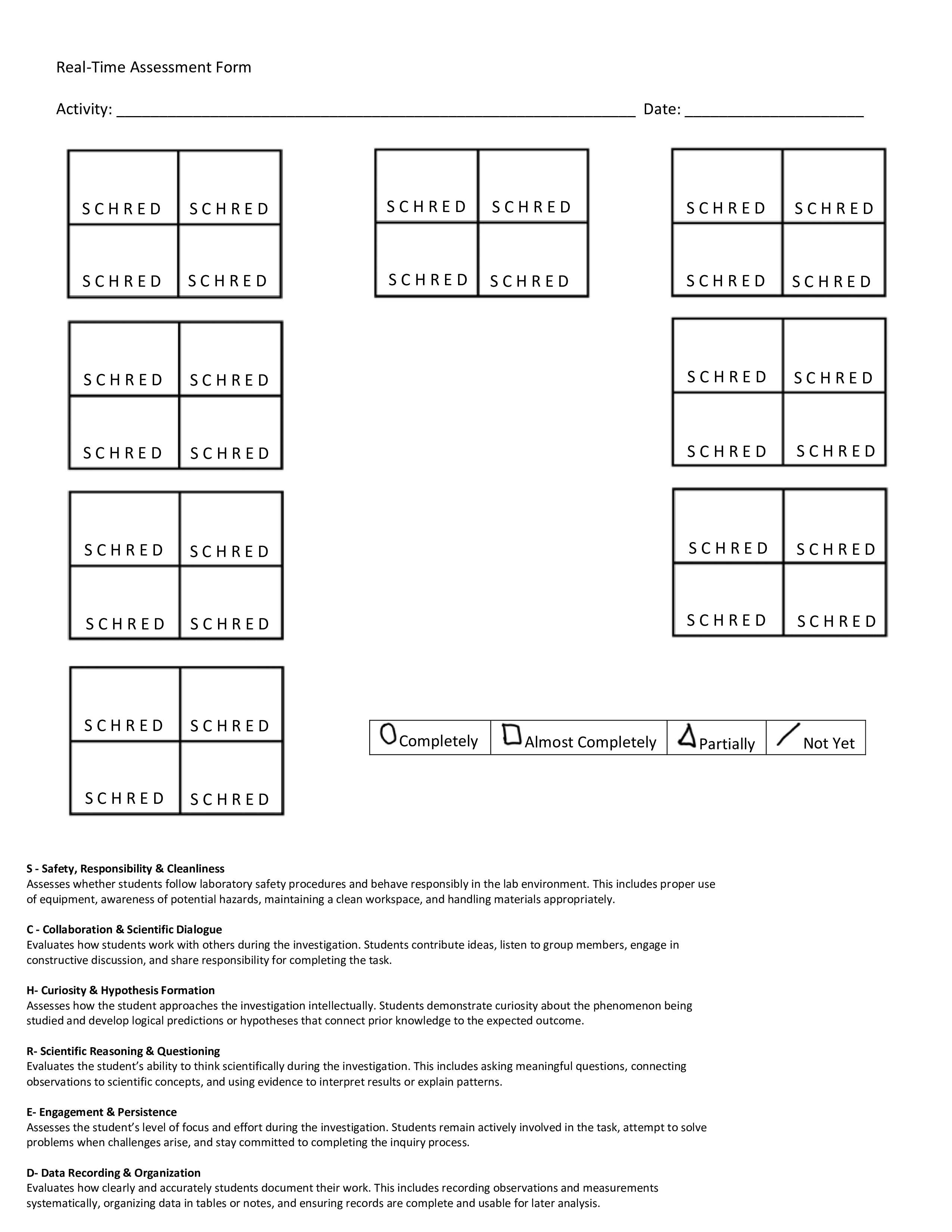
Inquiry lab; data recording tables; observation rubric; partner conversation on sources of error; lab analysis HW. |
Lab AFL AAL |
| 11 Wed Apr 8 — Literacy Focus Visit (Full Period) |
A1.3, A1.7, A1.9, A1.11 |
Apply explicit literacy strategies to analyse texts on electrochemical energy technologies. |
Annotate a structured text set; identify argument structure; write a CER paragraph on the viability of one electrochemical technology; self-assess reading/writing process. |
Co-planned literacy lesson with visiting committee; before/during/after reading; CER paragraph writing. |
AAL (self-assessment) |
| 12 Thu Apr 9 — Consumer & Industrial Cells |
A1.7–A1.11 |
Compare primary/secondary cells, fuel cells, and metal-air cells; evaluate design trade-offs. |
Explain differences among dry cells, lead-acid, Li-ion, and fuel cells; discuss energy density, rechargeability, and environmental issues. |
Debrief literacy day; jigsaw expert groups each present one cell type; comparison table; optional fuel-cell video. |
AAL |
| 13 Fri Apr 10 — Corrosion as Electrochemistry |
A1.8, A1.11 |
Explain corrosion as a spontaneous electrochemical process; evaluate prevention methods. |
Describe anode/cathode regions in corroding metal; explain galvanizing, painting, cathodic protection; connect to health/safety/environmental issues. |
Image think-pair-share; corrosion cell explanation; concept mapping of causes and prevention; optional community observation HW. |
AAL |
| 14 Mon Apr 13 — Electrolytic Cells vs. Galvanic Cells |
A1.6, A1.8, A1.11 |
Distinguish electrolytic from galvanic cells; explain non-spontaneous redox and external power. |
Explain flipped electrode polarity and direction of electron/ion flow; analyze electrolysis of molten NaCl and aqueous CuSO₄. |
Venn diagram starter; textbook electrolytic cell study; diagram analysis; quick formative quiz. |
AFL |
| 15 Tue Apr 14 — Industrial Electrolysis |
A1.3, A1.7–A1.11 |
Describe industrial electrolysis processes; connect to STSE issues. |
Explain Hall-Héroult, chlor-alkali, and electroplating/electrorefining processes; identify electrode reactions and environmental/safety considerations. |
Brainstorm prior knowledge; jigsaw group annotated diagrams; gallery walk with peer feedback. |
AAL |
| 16 Wed Apr 15 — Faraday's Law: Quantitative Electrolysis |
A1.6, A1.8, A1.13 |
Apply Faraday's law to calculate mass deposited/consumed; connect moles of electrons to stoichiometry. |
Use I, Q, t relationships; calculate theoretical mass in multi-step problems; note and correct one error from self-check. |
Current/charge/time review; modelled Faraday examples (copper plating, H₂ production); scaffolded practice set; self-check answer key. |
AAL |
| 17 Thu Apr 16 — LAB: Electroplating & Faraday Verification |
A1.2, A1.4–A1.6, A1.8, A1.11–A1.13 |
Carry out quantitative electrolysis lab; compare theoretical and experimental mass. |
Plate a metal object using CuSO₄; measure current and time; calculate theoretical mass with Faraday's law; analyze % error and sources of discrepancy. |
Formal electroplating lab; data tables; Faraday calculations; structured lab report with error analysis. |
Lab AOL or major AAL |
| 18 Fri Apr 17 — Mid-Unit Quiz & Consolidation |
A1.6, A1.8, A1.11–A1.13 |
Demonstrate understanding of redox, cells, and industrial processes to date. |
Answer questions on balancing, redox tables, cell diagrams, E° calculations, and qualitative electrolytic reasoning; identify two personal learning goals from quiz results. |
Small-group concept map (all unit terms to date); written quiz; immediate answer-key debrief. |
Quiz AOL |
| 19 Mon Apr 20 — Complex Problem-Solving & Applications |
A1.6, A1.8, A1.11–A1.13 |
Integrate multiple electrochemistry concepts in multi-part problems. |
Solve problems combining redox balancing, E° calculations, galvanic vs. electrolytic reasoning, and quantitative electrolysis; explain reasoning aloud on whiteboards. |
Mixed integration problems on whiteboards in small groups; teacher quick-conferences and observation checklists. |
AFL AAL |
| 20 Tue Apr 21 — STSE Synthesis & Performance Task |
A1.3, A1.7–A1.11, A2.1–A2.2 |
Connect electrochemistry to societal, environmental, and career contexts; begin performance task. |
Explain benefits and risks of one electrochemical technology; develop a position paper/infographic/mini-presentation outline referencing STSE issues. |
Video/case study quickwrite; jigsaw STSE discussion; class share; performance task outline drafting with shared rubric. |
AAL |
| 21 Wed Apr 22 — Structured Unit Review |
A1.6, A1.8, A1.11–A1.13 |
Self-assess readiness on each subtopic; fill remaining gaps before unit test. |
Identify personal strong/weak areas using self-assessment; successfully complete station problems on redox ID, tables, galvanic cells, electrolytic cells, and Faraday. |
Student-generated question bank; five-station rotation with answer keys or mini-conferences; self-assessment readiness checklist. |
AAL (self-assessment) |
| 22 Thu Apr 23 — Lockdown Drill + Light Consolidation |
A1.4 (safety context); consolidation of F-strand expectations |
Review lockdown safety; consolidate prior learning through low-stakes activities. |
Participate in lockdown drill procedures; contribute to collaborative concept map or Kahoot review; ask clarifying questions about unit content. |
Safety briefing; lockdown drill (20–30 min); post-drill collaborative concept map, Kahoot, or student Q&A. No new content. |
AFL (low-stakes review) |
| 23 Fri Apr 24 — Unit Test |
Summative sampling of A1 skills; F-strand expectations |
Demonstrate comprehensive understanding of SCH4U electrochemistry. |
Answer qualitative and quantitative questions covering: redox concepts and balancing, redox/standard potential tables, galvanic cell structure and E° calculations, electrolytic cells and Faraday's law, STSE issues/applications. |
Written unit test (full period); brief debrief or reflection on learning habits if time permits after test. |
AOL (summative test) |